Ron Rinauro, Blown Hell 1 & 2 (1965 to 1967)
Ron Rinauro lived a couple of blocks from my parent’s house in Mtn. View, at 567 View St. He was 3 years older than me and his parents owned and operated our local garbage company, Foothill Disposal. I never really knew Ron growing up, but as I got older, I would take the long way home in order to pass by his house to check out his car projects, and overtime we became good friends, and I started helping him work on those projects.
Ron’s first car, which he bought new, was a 1955 Chevrolet, Bel Air, with an automatic transmission. He liked to show it off on High School Way, a street that ran alongside our high school. He would quickly back-up and then shift the transmission back into drive, smoking the rear tires down the street (and we loved it). Not long after Fremont Drag Strip opened in late 1959, Ron took the 55 to the track to see what drag racing was all about, and he got the racing bug, and started adding high performance parts to the car’s engine, and by the end of 1960, the 55 had become a full-time race car.
Ron raced his 55 in NHRA’s C and D gas classes (both non-supercharged classes), until February of 1965, when he took the car to Al’s Auto Parts in Mountain View, to have it upgraded to race in a “supercharged gas” class. Al’s was a parts store and machine shop that repaired cars and rebuilt engines, along with doing custom engine installations. The store also sold speed equipment and racing newspapers such as Drag News, National Dragster, and a couple other circle track racing papers. Al’s was a happening place from around 1962, until its owner, Ed Decker, decided in 1966 to move the business to Oakdale, Calif. Al’s was a stopping-off place for ‘car guys’ on their way home from work, usually just stopping by to bench race.
Bob Ravetto ran Al’s machine shop and did the majority of the upgrades on Ron’s 55, which included adding a 671 supercharger, Hilborn fuel injection, custom camshaft, custom exhaust headers, larger rear tires, radiusing the rear fender openings, and replacing the 55’s steel front fenders and hood with fiberglass parts. Also around this time is when Ron had a local sign painter add the name “Blown Hell” to the side of the car. The car and its small block engine were very successful in the supercharged gas class, becoming an NHRA track record holder.
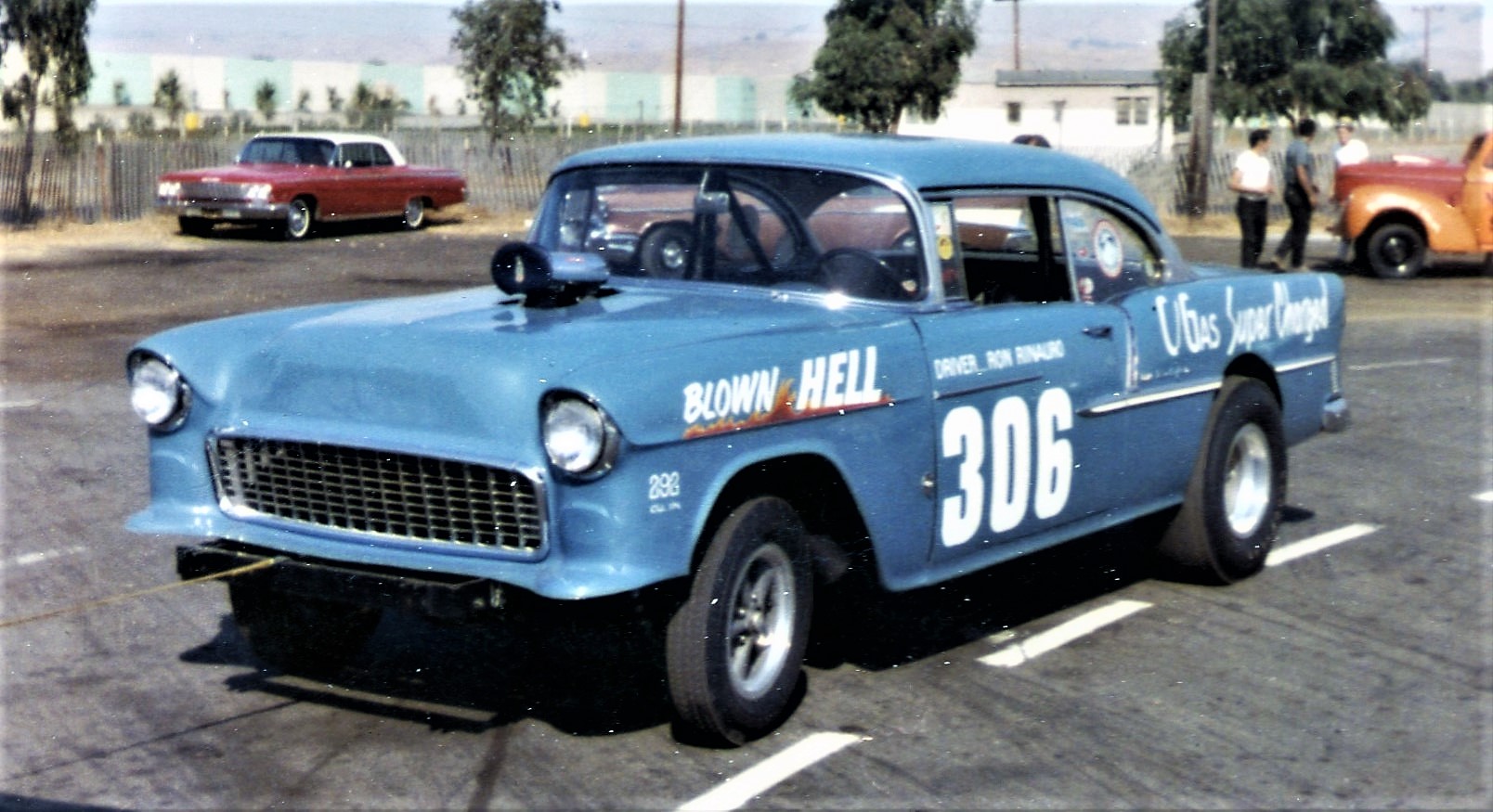
In late 1965, after racing the 55 in the C-Gas Supercharged class for several months, Ron, decided to switch from gasoline to alcohol to increase the engine’s horsepower. And because of the fuel change there wasn’t a real class for this type of car, but several others were doing the same thing which led to a couple of match races, with Ron’s 55 getting invited to a match race in Los Angeles! A trip to L.A. was a long trip compared to our short trips to Fremont and Half Moon Bay drag strips, where we normally ‘flat-towed’ the race car to the track using a tow bar, but because of the length of this trip Ron decided to use one of his father’s ‘company’ trailers.
By this point the 55 was pretty much stripped of all its street gear leaving only one bucket seat for the driver. So, for our trip to L.A. this allowed us to store an extra pair of mag wheels with mounted tires inside the car, along with a couple of 5-gallon cans of alcohol in the trunk. The trunk area was now an empty space except for two permanently mounted batteries that were used to start the car’s engine.
Ron, Joe Faso, and I left for Los Angeles, on a Friday night around 9:30, and planned on driving all night. But as we were crossing over the Pacheco Pass on highway 152, Ron spotted a fire in his rear-view mirror coming from inside his 55. He quickly pulled over to the side of the road close to where the San Luis Reservoir Visitor Center is now located, about a half mile from the dam’s face. We had just enough time to disconnect the trailer before the interior of the 55 was completely engulfed in fire, and with no cell phones in those days, we just sat there and waited for help.
When the Fire Department finally arrived the guy in charge, I guess he was the Fire Chief, was a ‘know-it-all’. I told him about the magnesium wheels and its reaction to water and he told me not to worry. He said he had served in the Navy and was very familiar with this type of fire. And by the time his men got their stuff together to try and put out the fire, I could see the magnesium wheels and tires burning inside the car!
I knew from my childhood chemistry set, and one of my high school science classes, that adding water to burning magnesium wasn’t a good idea. The heat from molten magnesium is so hot (above 5,600 degrees), when water is added to the mix it creates an explosion. And that’s exactly what happened when the Fire Chief told his men to direct their water to the interior of the car. The car blew-up like a small bomb, throwing white hot magnesium and fiberglass parts hundreds of feet away from the car, and starting a couple of fires to the nearby brush along the highway.
After the fire department put out the small forest fire they created, they began removing the burning magnesium and rubber from the interior of the car with shovels, which by now had started melting holes in the cars steel flooring. This effort only lasted for a couple of minutes, that’s how long it took for the molten magnesium to melt through their steel shovels. So much for this Fire Chief’s Navy experience! After that the fire department crew just sat around and waited for the fire to burn itself out, which was around 5:30 in the morning.
After the car cooled off, we looked for the cause of the fire and discovered one of the alcohol cans in the trunk had slid over and made contact with the battery’s positive terminal, which had been disconnected from the battery before the trip, but left a large bolt-on terminal exposed! The electrical arcing burned a hole in one of the alcohol cans setting the alcohol on fire, allowing the liquid alcohol to run from the trunk floor pan to the driver’s compartment. The fire burned away the fiberglass front fenders and hood, and melted parts of the steel body, but surprisingly the engine and running gear had little or no damage and would later be used on the second ‘Blown Hell’. And the car trailer, it only suffered smoke damage and a couple of burnt tires.
The next day we went to Ron’s father’s house (1290 Bryant Ave.) to explain what had happened on our trip. His father didn’t say much, he just listened. When Ron was done telling the story his father picked up the phone and called someone (which sounded to us like his insurance agent), and the last thing we heard his father say on the phone; “you’ve got 30 minutes to find a way to insure my son’s stuff”! And about 25 minutes later he received a call back saying all the stuff was insured because the trailer was a Foothill Disposal Company asset. It was a scene right out of the movie The Godfather, which didn’t come out until 9 years later. In less than a month Ron received a check for $15K to cover the losses! I couldn’t believe it.
The Birth of “Blown Hell II”
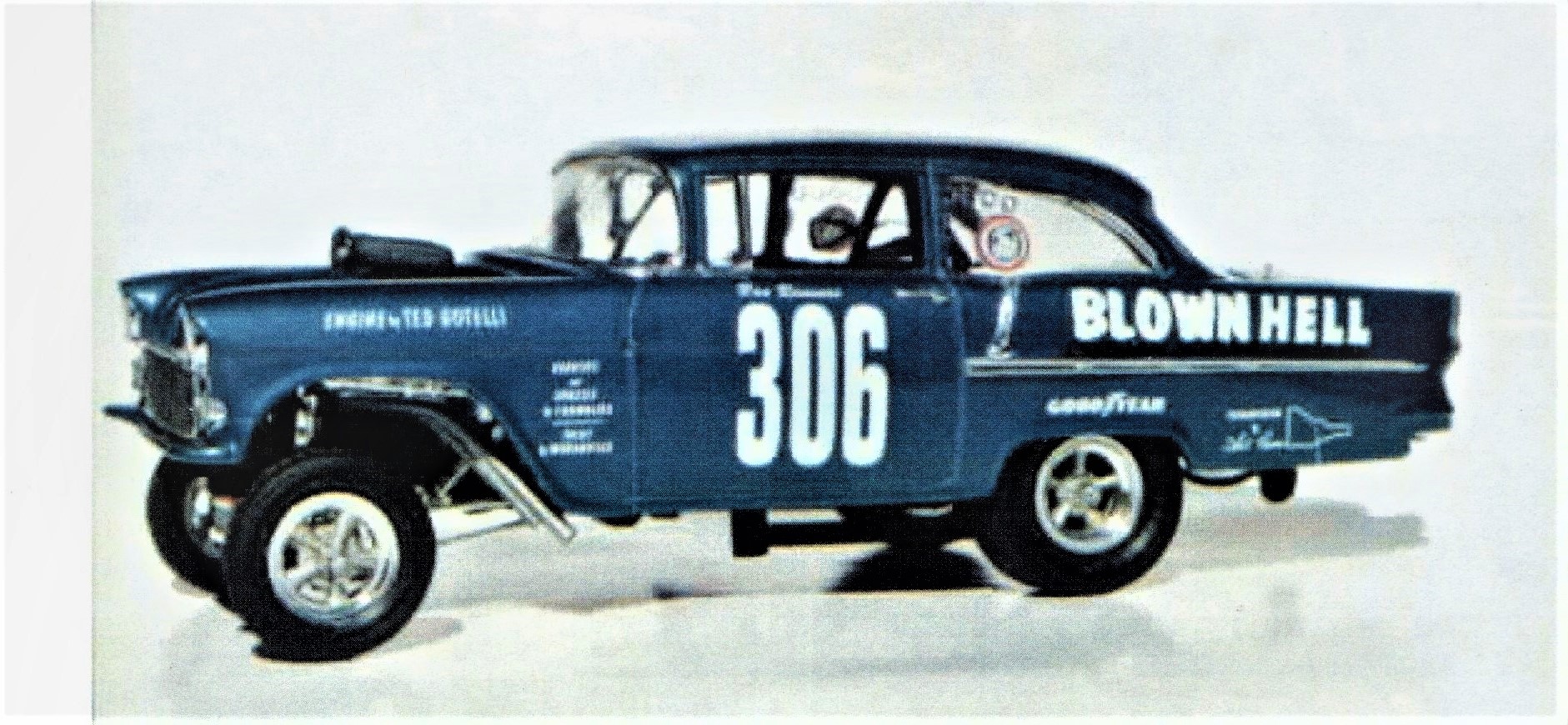
Bill Moranville, a friend whose father owned a body shop in town, found Ron a nice used 1955 Chevy Business Coupe to replace his destroyed 55. Ron wasn’t sure what drag race class he wanted to build this second 55 Chevy for. He was bored with the C Gas Supercharged class and he very much liked running his engine on alcohol. One thing we all liked during this time period were the modified Super Stock cars with their altered wheelbases and injectors sticking out of the hood. At the time there wasn’t a real class for this type of race car in either NHRA, or AHRA (this was before funny cars). These unusual cars were built to either make exhibition runs or to match race, ‘Run What You Brung’ style, which meant that anything goes.
So, between the three of us, Ron, Bill, and myself, we decided to alter the wheelbase of this second 55 Chevy, mainly because we thought it would be a fun project, and would attract a lot of attention when completed. To start the project, the car was completely gutted of all its extra interior sheet metal (fender well tubs, flooring etc.), except for a section of steel flooring in the driver’s compartment.
I started by narrowing and shortening the 55’s rear frame rails 20 inches. Then Bill and I moved the rear fender well openings forward 20 inches, which turned out to be a very slow job, using only a hand-held hack saw blade, and requiring hundreds of tack welds. For the rear suspension I used a 1957 Oldsmobile axle housing, rectangular lift-bars, Corvair coil springs, and Watts linkage. I also used rectangular tubing to extend the front frame rails and wheelbase by 6 inches. I built a tubular straight front axle that used a semi-elliptic cross spring, 1940 Willys spindles, and a Corvair steering box. The first roll bar I built was located just behind the driver’s seat, which I later changed to a full roll-cage when we switched to a big block Chevy engine, to meet NHRA’s safety requirements.
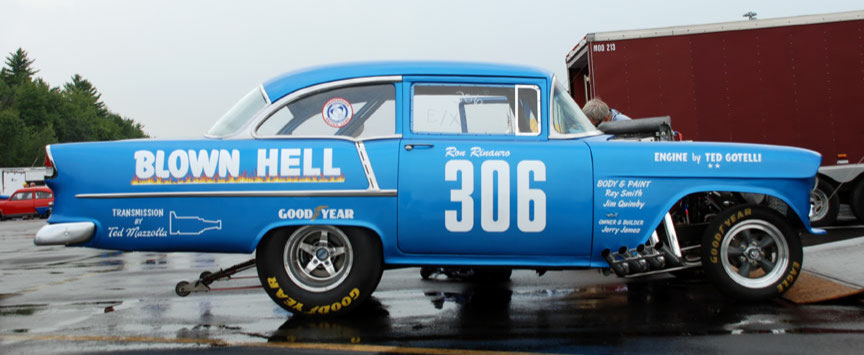
The 55’s steel doors, front fenders, and trunk lid were replaced with fiberglass parts, and except for the windshield, all the glass windows were replaced with Plexiglas. And for some reason, Ron never purchased a hood for the car. Bill did all the body work and painted the car an unknown blue color. Bill and I also made up fiberglass front and rear bumpers, using the inside of the stock bumper as a mold. The car’s lettering was done by a local sign painter in town (name unknown), and Formway Machine Shop of Los Altos, Calif. built the custom aluminum interior.
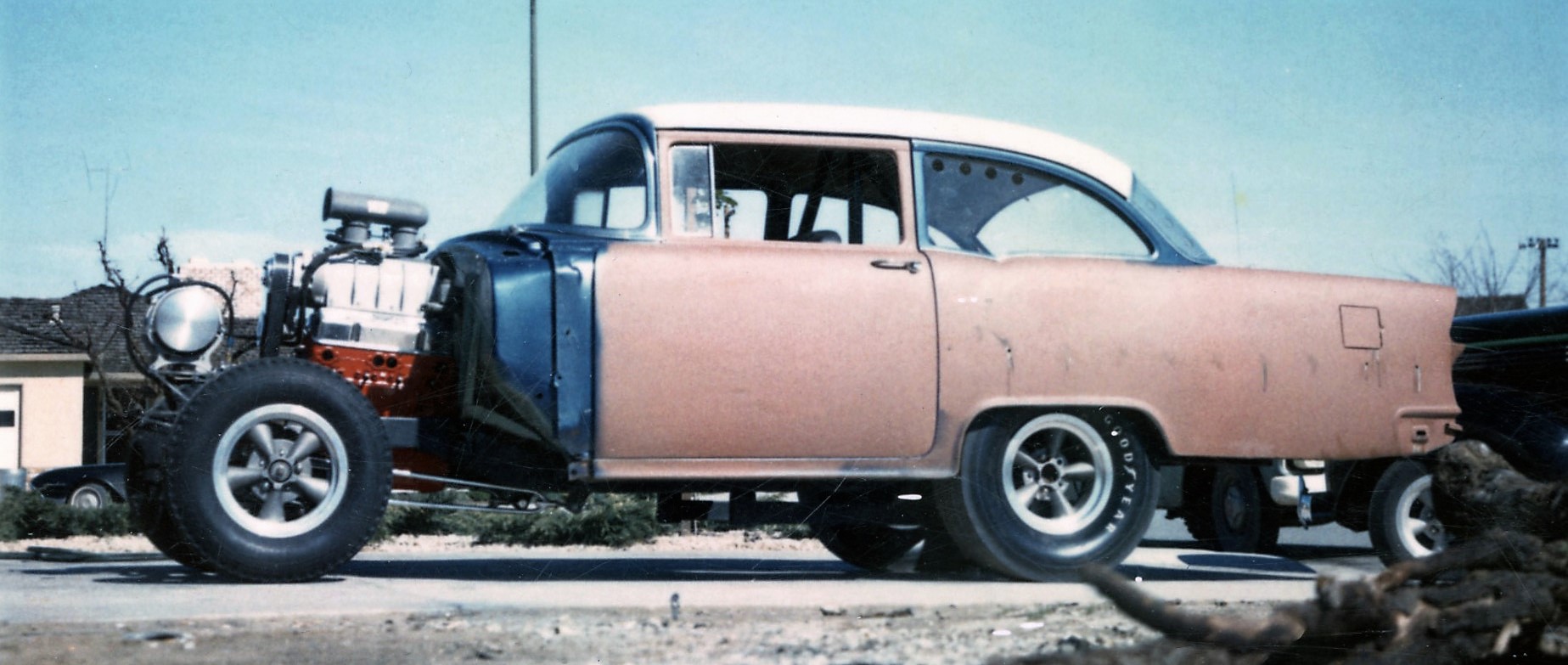
We used the same small block Chevy engine out of Blown Hell number one, without even taking it apart after the fire, we just gave it an external clean-up! And the Corvette 4-speed transmission used in the first Blown Hell was replaced with an L&M Torqueflite (a local transmission shop in Redwood city), and later replacing that with an Art-Carr Torqueflite.
The car was raced for 6 months or so with the small block Chevy engine before it was replaced with a 427 cubic inch big block Chevy engine, which was built by Ted Gotelli. The car ran in the mid to low 9 second range with the small block, and I don’t remember its actual speeds, but it was most likely around 150mph. After switching to the big block engine Ron continued using alcohol as its fuel, but occasionally added a little nitromethane, usually 10 or 15%. The nitro was more for its effect on the sound of exhaust and its smell, rather than increasing the engine horsepower.
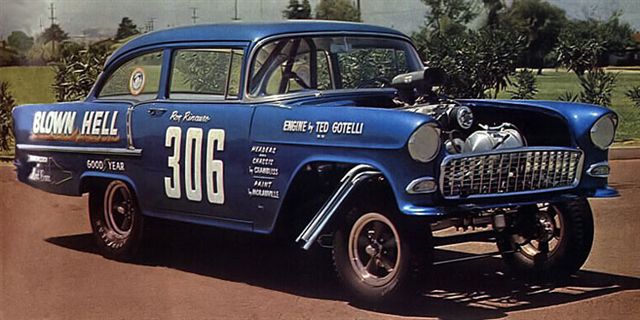
With the increase in horsepower from the new big-block engine, the car’s high center of gravity had an adverse effect on the car’s handling in high gear. To help solve this problem I built a 5 inch dropped front axle to lower the front end of the car. The new big block engine got the car into the 8 second bracket with speeds up to 170mph. Not having a class for this type of race car, NHRA issued Ron a special unlimited driver’s license, 7D-367 Unlimited. After a year or so of match racing the 55, there were rumors that NHRA was going to create an eliminator bracket, or class for these types of match race cars, with class rules!
One of the rumors was; all bodies had to be a recent model year, or no older than 5 years. This meant that match races for the older altered wheelbase cars would probably dry-up. And in 1968 NHRA did create a category for ‘match race and exhibition cars’, and then in 1969 they created the Funny Car class. This was the first use of the words “funny car” in an NHRA rule book.
With so much uncertainty about the future of match racing and exhibition cars, Ron decided to sell “Blown Hell” and get back into Gas Supercharged racing, his roots, and the timing was right. The Gas Supercharged classes were at the height of their popularity in 1967. Ron sold the car less its engine and transmission to Curt Dickerson, a local Mountain View guy. Curt’s plan was to make the 55 into a street car using a Chevy engine and trans, but I’m not sure if that ever happened. He did sell the car after a couple of years to another local person who basically stored the car for several years, and then sold it to an unknown person.
The car then disappeared for 20+ years before being found in a barn in Bakersfield, by another unknown person, who took the car to a swap meet at Sears Point, in 1995, to sell it. The car was bought by Lenny Vonkolstadt of Menlo Park, Calif., who sort of restored the car, adding signage that tried to connect Jungle Jim Liberman to the car. And of course, there was no Jim Liberman connection to the car other than we were all friends.
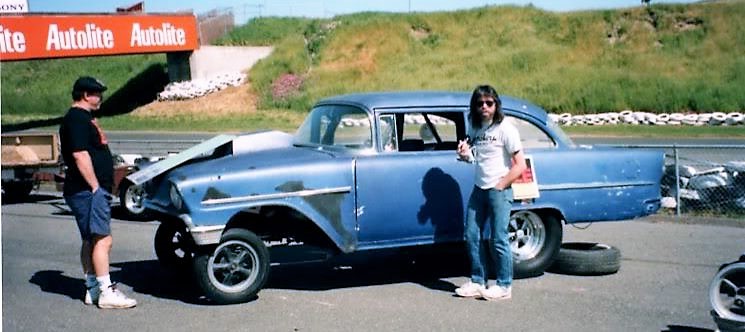
After Lenny cleaned up the 55, he showed it at local car shows around the Bay Area for several years, and then sold the car in 2015. The car changed hands several times until 2019, when it was bought by Rick Souza of Campbell Calif., who planned on restoring the 55 to its original 1966 condition.
Over the years several plastic models of the 55 have been made, and in 2013, I read about a clone of “Blown Hell” that was built in New Hampshire. Amazing, a model, and now a clone!


Leave a comment