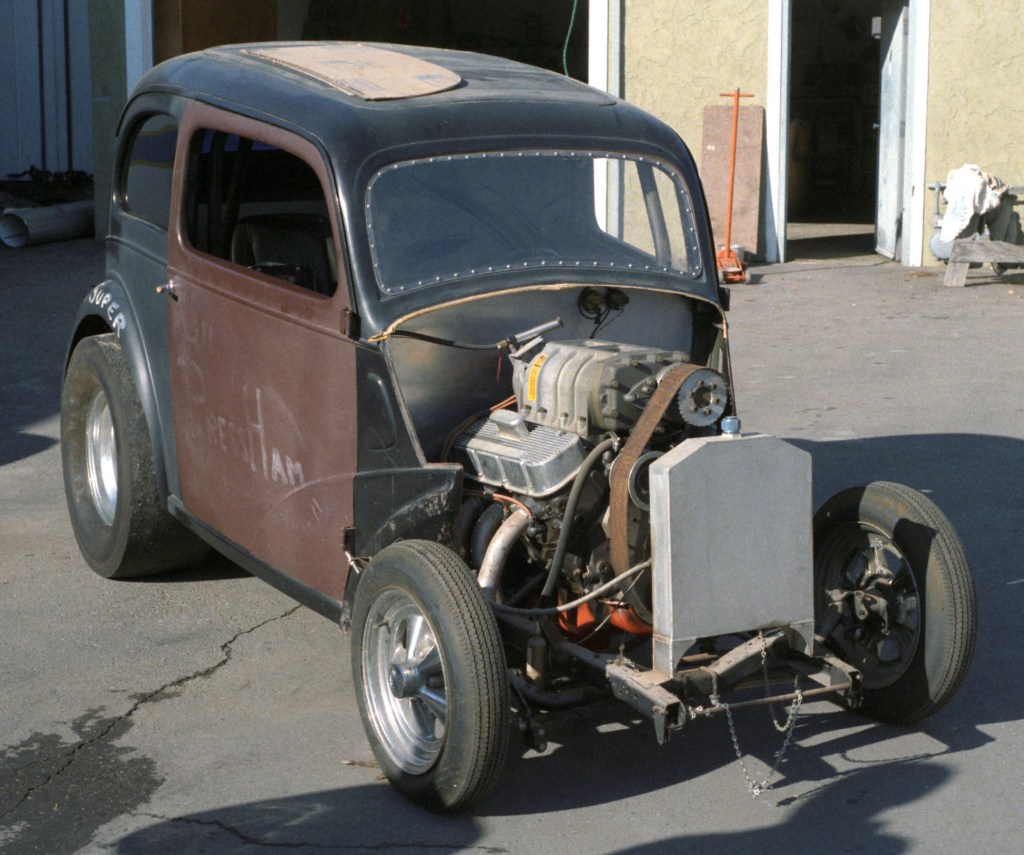
1948 Anglia Sedan (1965 to 1967)
In 1963, NHRA started allowing short wheelbase foreign cars (less than 94 inch) to compete in their gas classes with a couple of restrictions; non-supercharged small block engines only. One of the most popular foreign cars they allowed was the late 40’s, early 50’s Anglia sedans. And after checking out the Kohler Brothers Anglia at the 1965 NHRA WinterNationals race in Los Angeles, I decided to try and find one to build for the B gas class, using a small block Chevrolet engine.
In the fall of 1965, after looking for several months, I found a stock 1948 Anglia sedan for sale in Alameda Calif., less its engine and transmission. After looking it over and finding it to be in very good condition, I bought it for $75.00. There was only one problem, I didn’t have a place to keep it. At the time I was living in a duplex with a one-car garage where I kept my 1954 Ford race car. But luckily, Ron Rinauro, the friend who was with me when I bought the Anglia, said I could keep the car at his house and use his garage to work on it. Ron Rinauro also lived in Mountain View and raced in the C/Gas Supercharged class.
A couple of weeks after buying the Anglia I started working on it in my spare time. I started off by removing the body and stock running gear. At the time NHRA class rules required that all gas-class cars use their original factory frames, no custom-built frames. They did allow the frames to be modified, but the side frame rails had to be original.
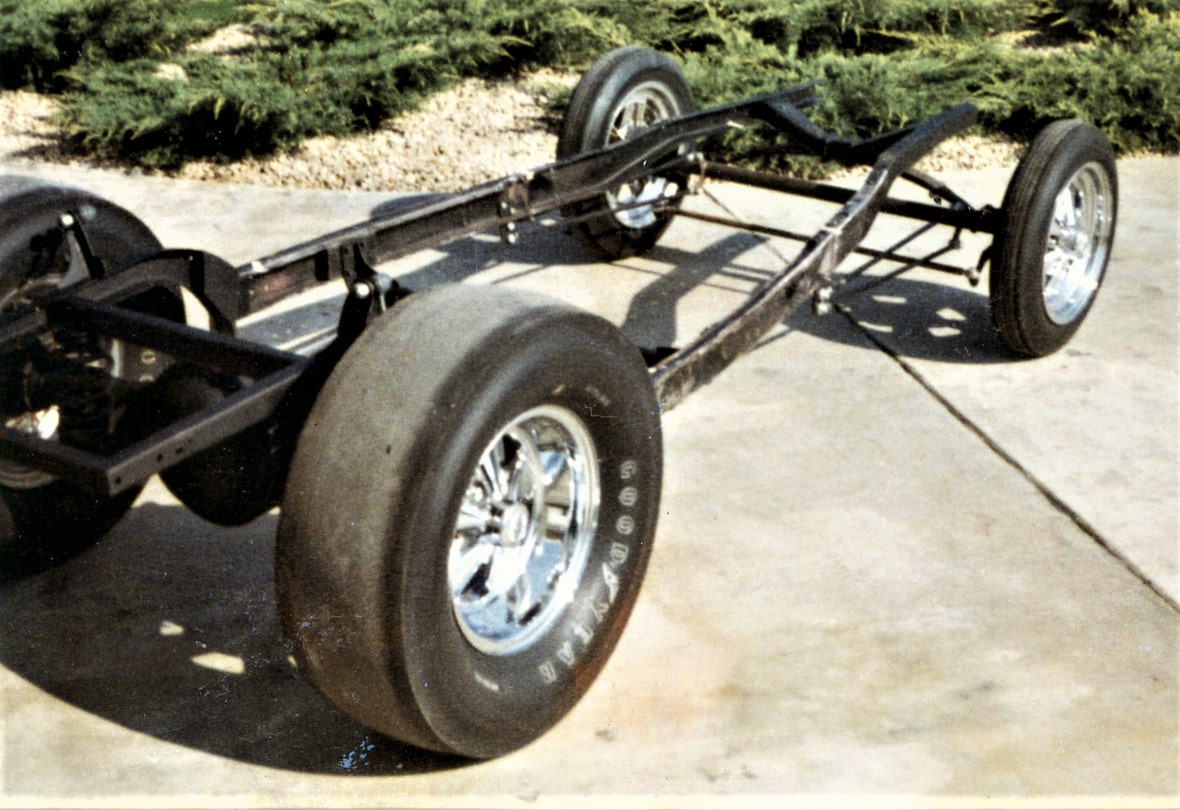
I left most of the frame stock except for places where I added brackets like the steering box, transmission crossmember, and motor mounts. At those locations I reinforced the frame by boxing in the frame rails. The biggest modification I made was to the rear of the frame where I narrowed and boxed it to allow for larger rear tires. I used the stock Anglia transverse spring for the front suspension and made a straight chrome-moly tube axles that used 1940 Willy’s spindles. For the steering I used a Corvair steering box, and I also used Corvair coil springs for the rear suspension (which were popular at the time). They were attached to a narrowed 1957 Oldsmobile axle housing. For traction I built a pair of rectangular tube lift-bars along with mounts for a pair of Monroe 50/50 shocks. And the roll-cage was built using chrome-moly tubing which was the key to making the lightweight Anglia frame rigid.
During the time my Anglia was at Ron’s house, his ’55 Chevrolet race car was totally destroyed in a fire on the Pacheco Pass (highway 152), on his way to a race in southern California. This significantly slowed down my spare time Anglia project while I built Ron a new race car, which I will cover in detail in another chapter.
My original plan was to build the Anglia to race in the B Gas class using a non-supercharged small block Chevrolet engine, but in either late 1965 or 1966, NHRA allowed foreign cars to use big block engines with superchargers. So, I changed my plans and switched to a big block Chevrolet engine to race in the A/Gas class with the possibility of later adding a supercharger to race in the AA/Gas class.
In 1966, I sold my ’54 Ford and was now able to devote more time to building the Anglia. Also, in 1966 we bought a house in Mountain View, located at 920 Tulane Dr. And within a month or so of moving in the new house, I had made the two-car garage into a work shop. Once that was completed, I moved the Anglia from Ron’s house to my Tulane shop, which allowed me to spend a lot more time working on it.
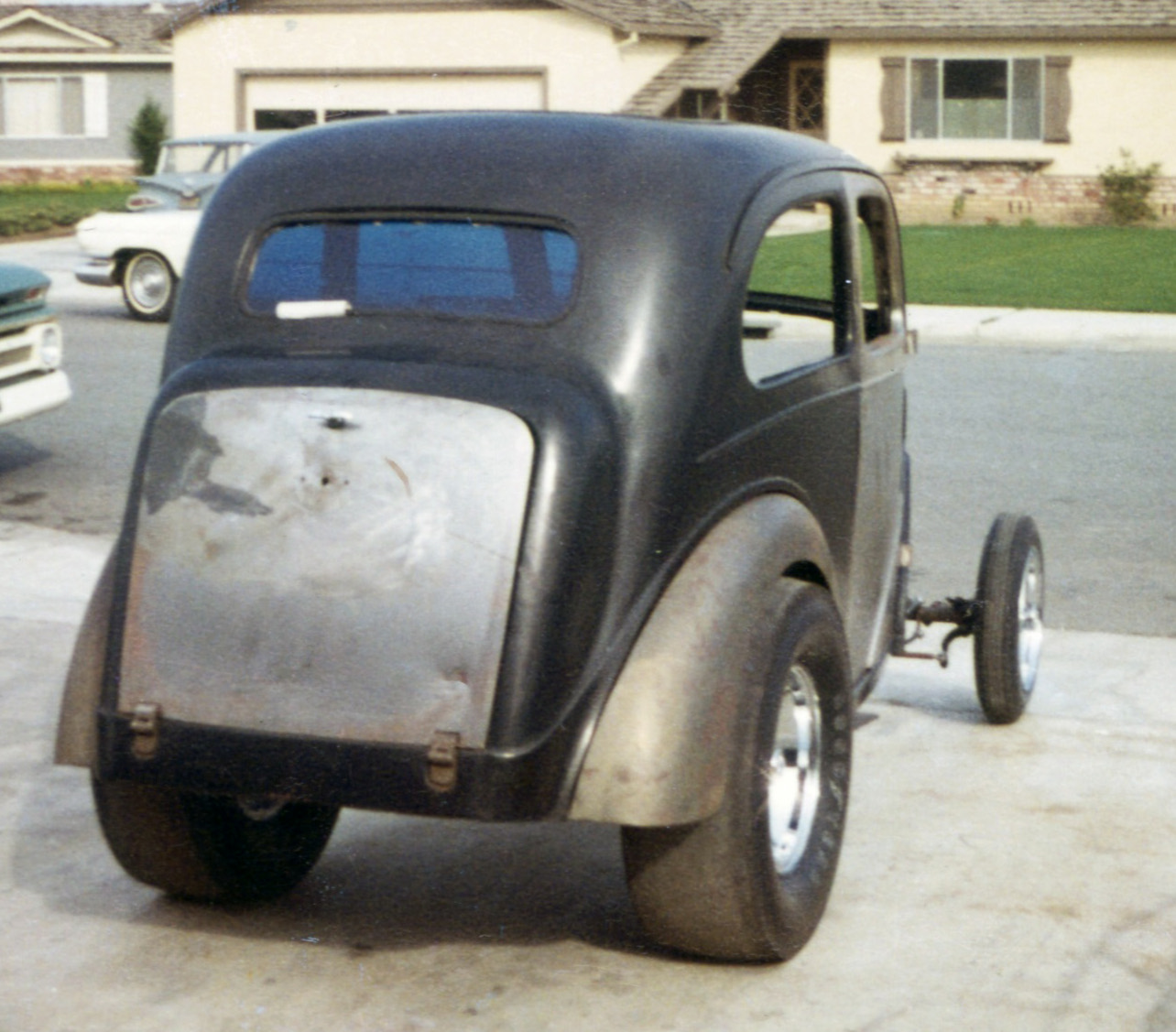
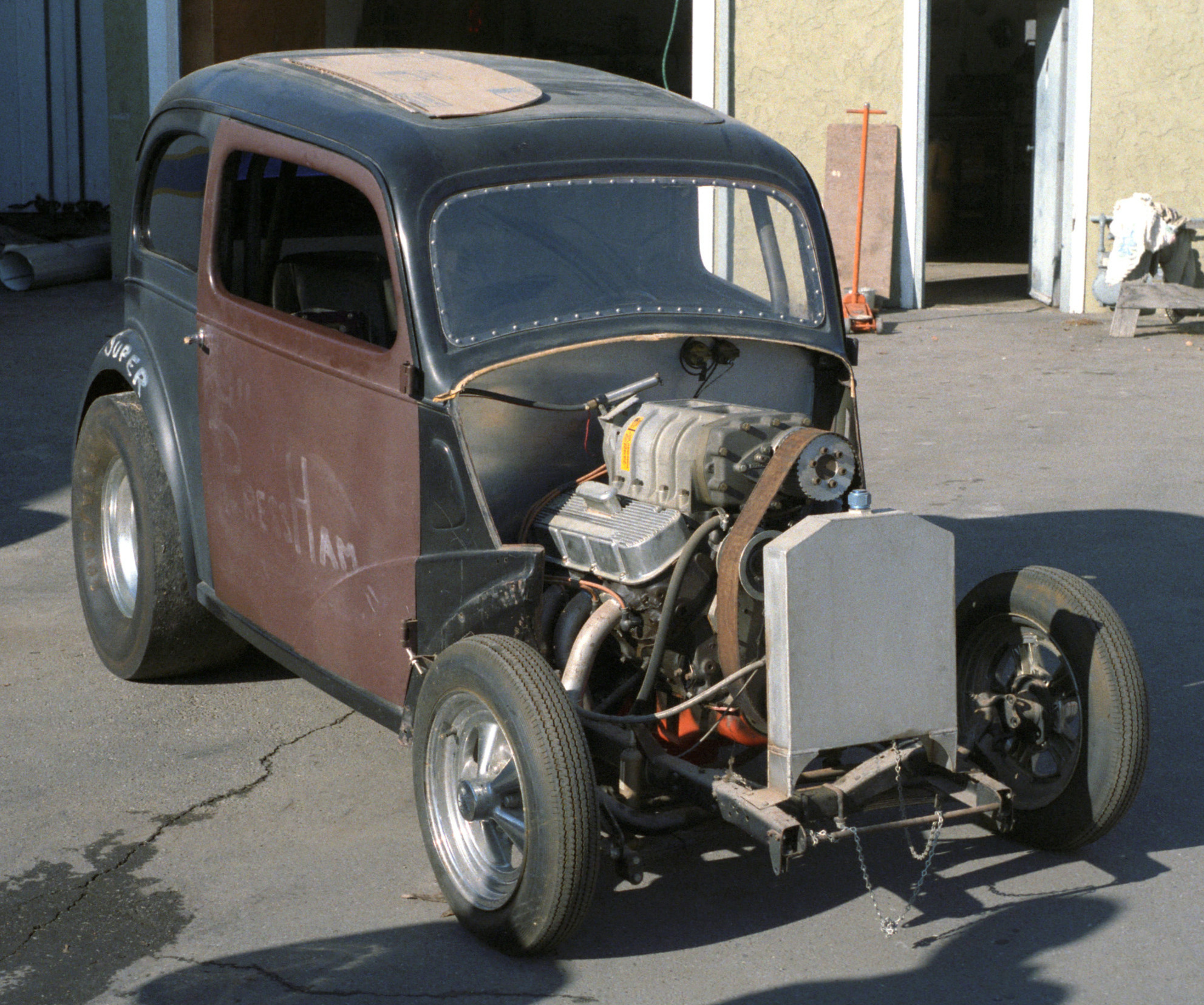
After removing the stock steel flooring and firewall from the Anglia body, I reinstalled it on the chassis so I could build the roll-cage, and the interior aluminum flooring and firewall. Also, to reduce the front-end weight of the car, I replaced the stock steel Anglia front fenders and hood with fiberglass parts made by Cal Automotive, in North Hollywood. I also added a pair of their fiberglass race seats. For wheels I used Cragar S/S, 16” x 8” in the rear, and 15” x 4” in the front. Cragar had just recently come out with the S/S line of wheels, which were very popular at the time.
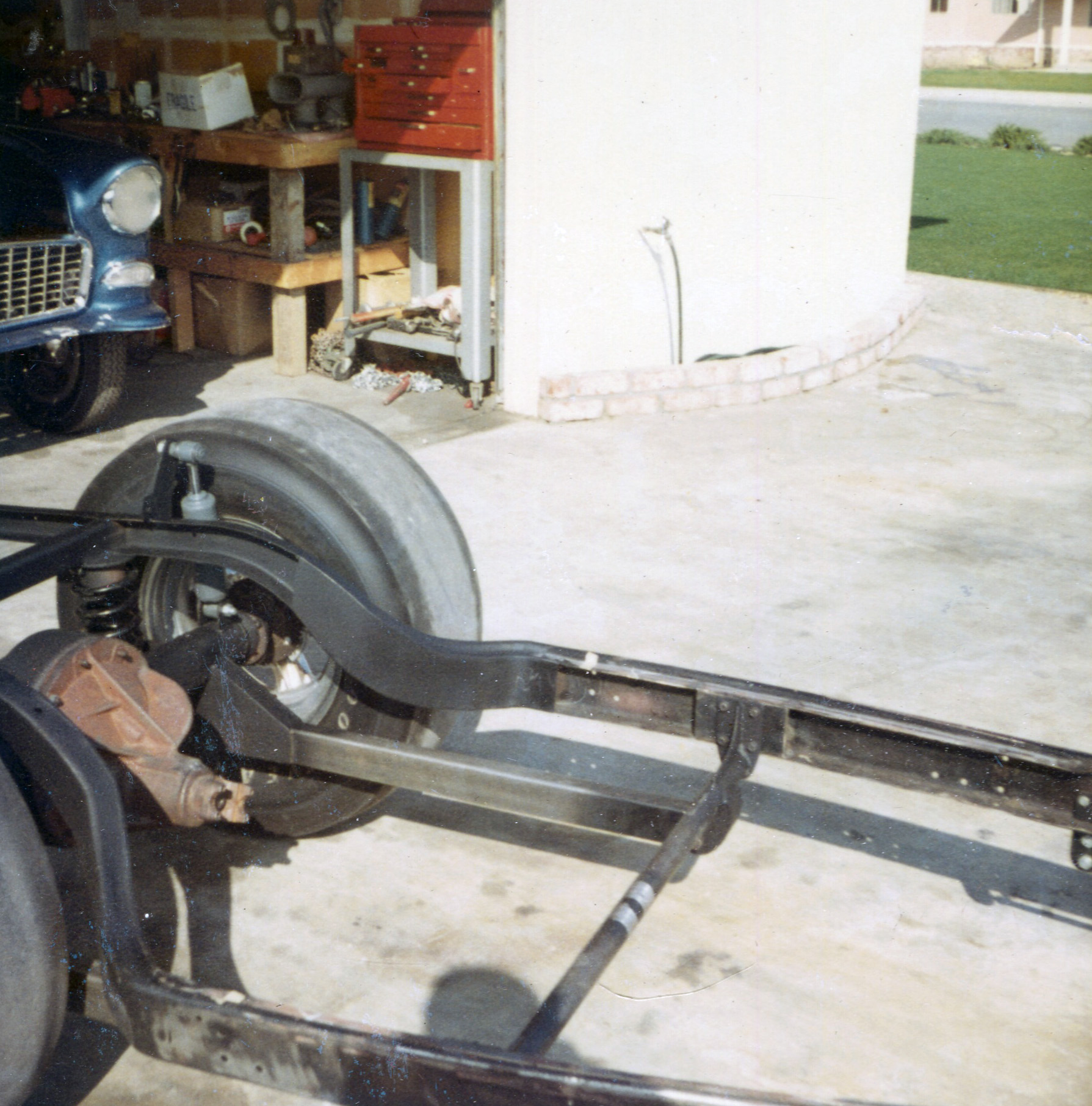
By the spring of 1967 I had the Anglia close to being finished, but with all the other car projects I had going on at the time, plus attending the races on the weekends I decided to sell it, less its engine and transmission. John Witt (alias Little John) of Hayward, Calif. ended up buying the car. He was a partner in the Brasher and Cummings 1933 Willys, which used his supercharged Chevrolet engine to race in the AA/GS class. When B&C decided to replace John’s Chevrolet engine with a Chrysler Hemi, it left John without a car. That’s when he decided to buy my Anglia and try racing on his own in the AA/GS class.
Because John already had a car trailer, I sold the trailer I had built for my Anglia to the Mallicoat Brothers for their new gas supercharged Barracuda.
After buying my Anglia, John took it to the Brasher and Cummings shop in Hayward Calif. to finish the car, which included installing his 467cu. in. Chevrolet engine, torque-Flite transmission, rear brakes, master cylinder, a fuel tank, seat belts, wiring, etc. By January of 1968, the Anglia was completed and taken to Fremont Drag Strip for testing, with Buzzy Wadsworth doing the driving. The car was a little shaky on its first three quarter run down the track, but on its second full run it recorded an elapsed time in the low 9 second range which wasn’t that bad for the second run on a brand new car. And even though the second run was a lot smoother and the elapsed time was in the ball park, drag racing technology had passed the Anglia by.
Rear suspension technology had changed rapidly since 1964, when I started building the Anglia, and by the time the car was finished and tested in 1968, its suspension was obsolete. It would never be competitive against the newer race cars that I and others were now building. Knowing this, John took the car home and parked it in his garage and over time lost interest in both the car and drag racing. The Anglia remained stored in his garage for the next 21 years.
Then in 1989, Lew Bratton of San Jose, Calif., heard through the grapevine about John Witt’s stored Anglia and tried contacting John to see if he was interested in selling it. Lew was interested in building a street car and thought with a little work the ex-race car would make a nice street car. After finally making contact with John, Lew found out he wasn’t interested in selling the Anglia. But after several meetings and phone calls over a period of a couple of months, John finally decided to sell the Anglia. The Anglia was in the same condition as when it last ran at Fremont Drag Strip; the only thing missing was the engine’s fuel injectors, which John had borrowed from Brasher and Cummings to make the test runs at Fremont.
A couple of months after Lew bought the Anglia, he decided it was just too small for his 6’3”, 220-pound body and decided to sell it. He ended up selling the car less its engine and transmission to Howard Anderson of Auburn, Calif., and I ended up buying the engine with plans on using it in one of my future projects. Howard’s plan was to update the Anglia to race in the new Vintage Drag Race Association’s A-Gas supercharged class. He ended up re-doing the Anglia from top to bottom which included chopping the top and having a new chassis built by Alton Chassis Works of Sacramento, Calif., For an engine, Howard and his brother Dan built a supercharged 420 cubic inch early Chrysler Hemi, that used alcohol for its fuel. Because of the Anderson brother’s attention to detail, the Anglia turned out to be a beautiful race car and it performed as well as it looked, running a best elapsed time of 7.18, with a top speed of 183.26 mph.
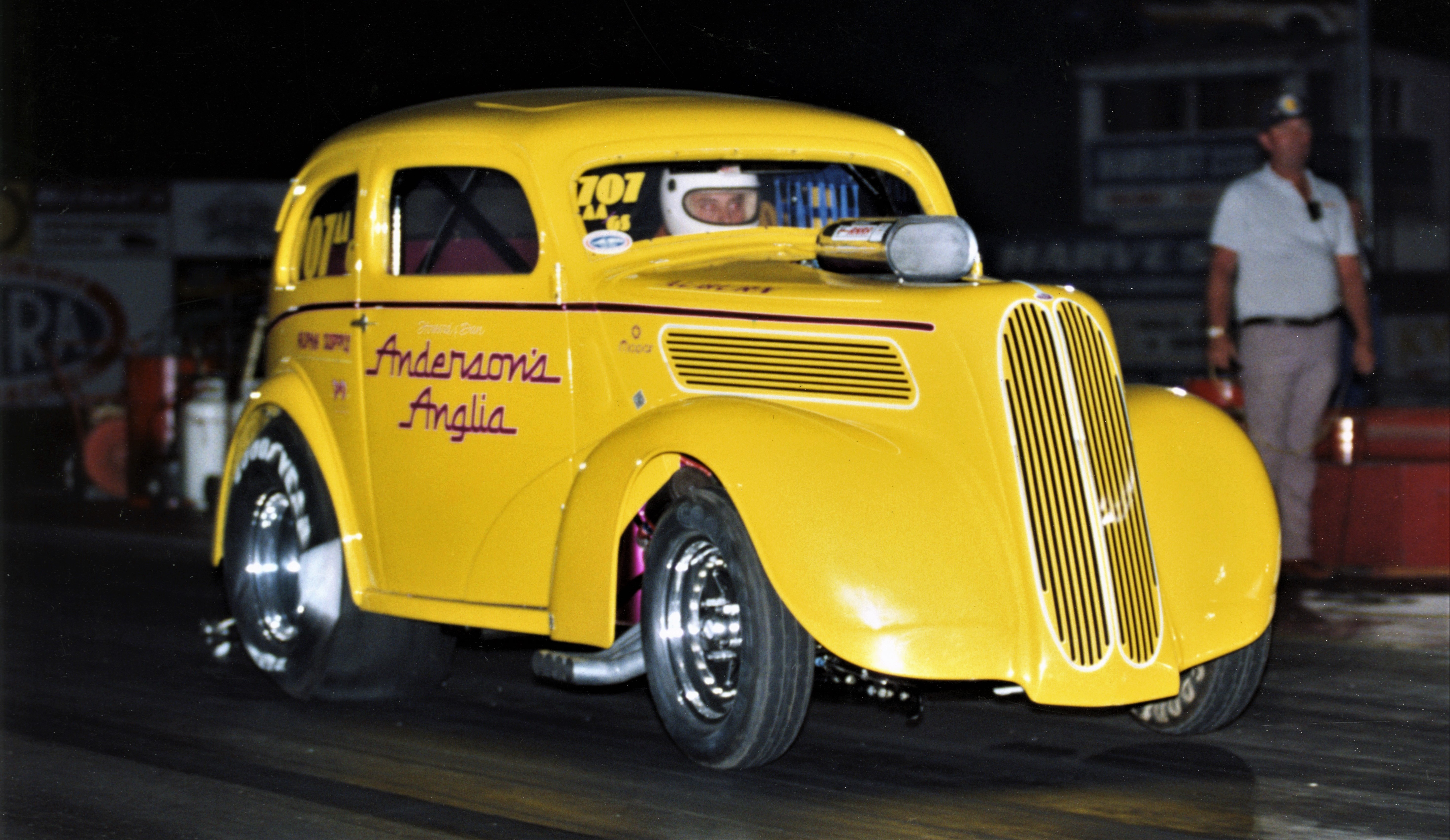
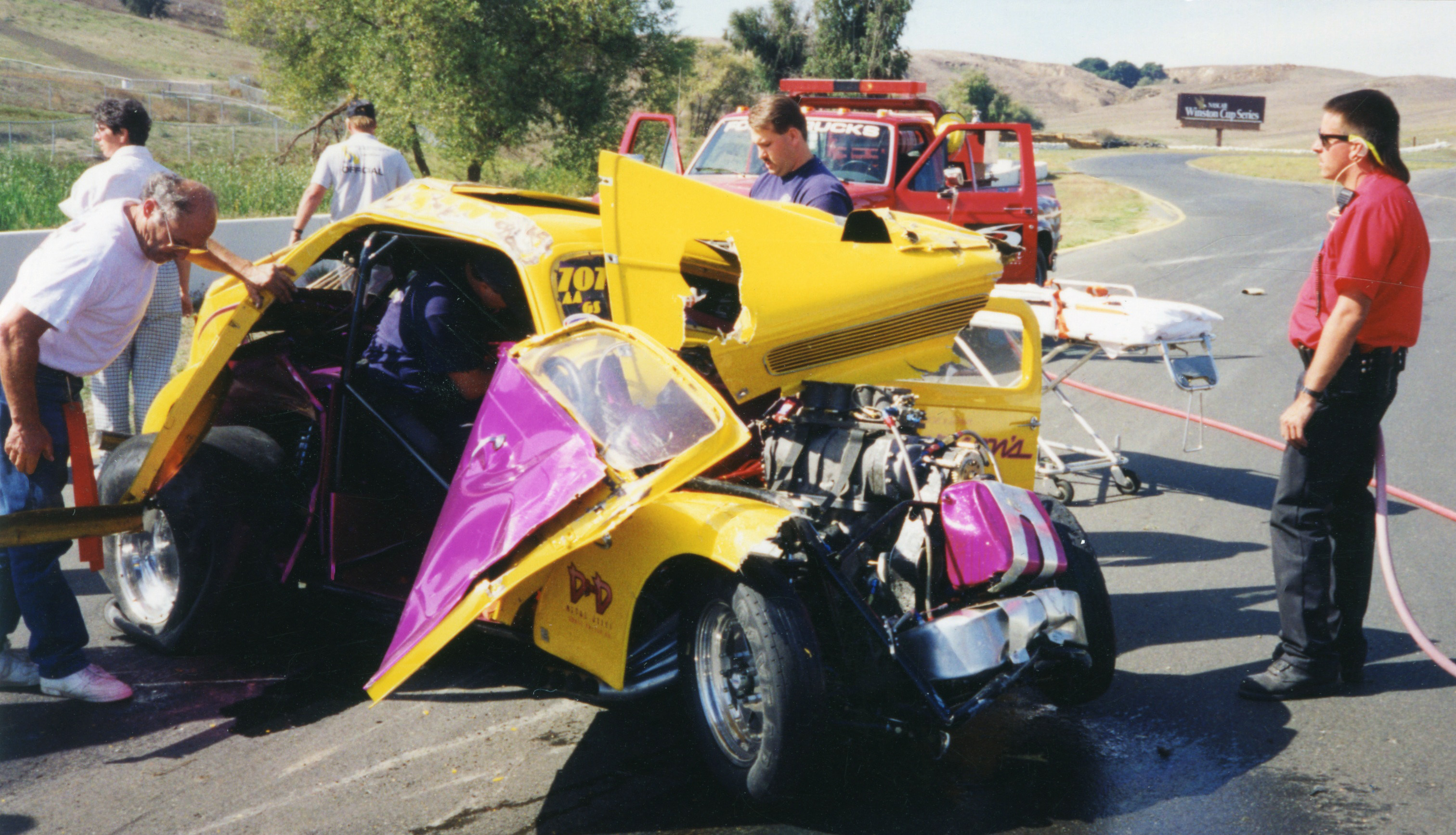
Howard and Dan raced the Anglia for a couple of years in the nostalgia AA/GS class until it was destroyed during a freak accident at Sears Point.
During a qualifying run at Sears Point, just prior to the car crossing the finish line a soft plug came out of the engine block allowing water to spray on the rear tires. The car slid and then rolled over several times completely destroying the car. Howard was unhurt, but shaken up.
The car was a total loss except for its running gear. A month or so after the crash the brothers decided to build a new race car using the old running gear, and asked me to design a chassis for their new race car. The new car turned out to be very successful, which I will cover in another chapter.
 Tom Chambliss: A Life in Stories
Leave a comment