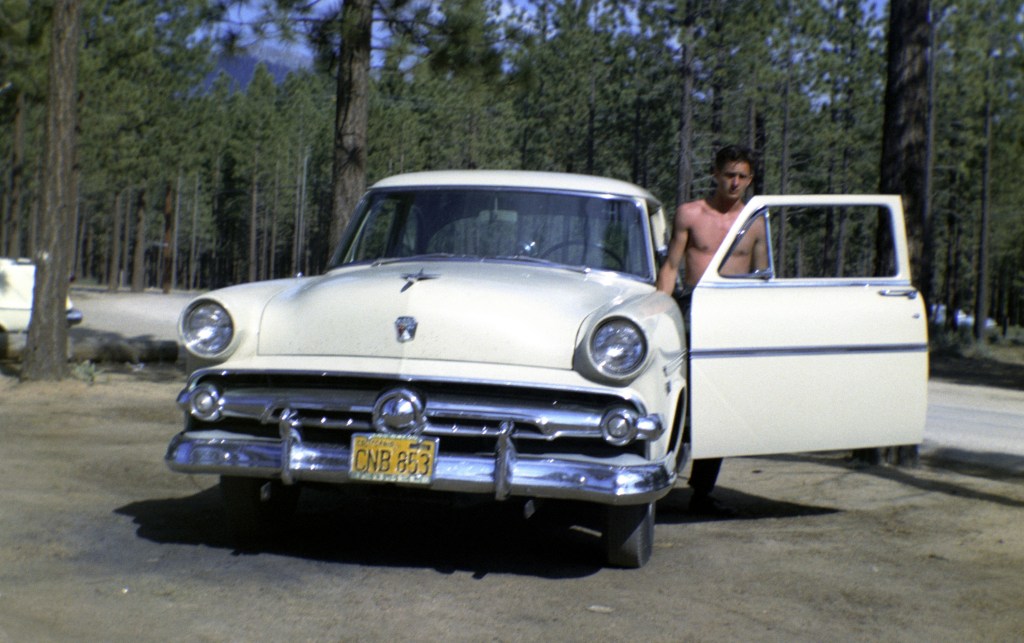
My 1954 Ford (1961 to 1968)
Around 1960, I started losing interest in the early Ford type of hot rods. This was partly due to girls entering the picture, and the need for a more comfortable car with creature comforts (radio, heater, defroster, etc.), and it also had to be capable of driving in all types of weather. Not having a particular make or model in mind, I started looking for a used car.
A friend, Joe Faso, had bought a used 1954 Ford in Modesto, Calif., with a bad engine that he planned on replacing. But after removing the engine and transmission, he lost interest and decided to sell it. I checked out the ’54 at Joe’s grandparent’s farm on Alice Ave. where it was stored and found the seven-year-old car to be in like-new condition. I didn’t really care for the look of the car because it was a coupe, preferring the look of a sedan with its longer roof line. But Joe only wanted $100 for the car, so I decided I could live with the coupe style. I bought the car in the fall of 1961, and my plan was to install a Chevrolet engine and transmission in the Ford, keeping its outside appearance stock, making it a “sleeper”, much like we had done with Ken Kline’s ’50 Ford coupe. Like my Model A Sedan, the make and style of the ’54 wasn’t my first choice, and it would be the second car I bought from Joe Faso.
In order to move the ’54, I built a tow-bar using 1948 Ford rear wishbones. At the time most drag race cars were flat towed to the race track rather than using an expensive trailer. I hadn’t planned on racing the car, but it was kind of cool to have tow-bar brackets mounted on the front of your car; permanent tow-bar brackets gave the impression the car was somehow connected to racing. A week or so after buying the car, I purchased a used 1958 220hp 283 cubic inch Chevrolet engine and PowerGlide automatic trans from a local auto wrecker with plans on rebuilding the engine before I installed it in the Ford.
I was now out of high school living at home, and working full time at Formway Machine Shop in Los Altos. I also occasionally worked on weekends and some evenings at a friend’s (Bob Gallagher) father’s Union 76 gas station on Willow Road in Palo Alto (just behind the Stanford Shopping Center). So, for the first time, I now had money to buy most anything I wanted.
In order to install the Chevrolet engine in the Ford chassis and clear its large front suspension crossmember, I had to use an oil pan from a new V8 powered Chevy II passenger car, which had the oil sump in the front of the pan, rather than the rear. To mount the engine to the chassis I used a Hurst universal front engine mount that bolted to the front of the engine and was connected to the frame by a couple of custom mounts I had made. Because I didn’t have an arc welder at home to weld the mounts to the frame, I towed the Ford to Bob Ravetto’s parents’ farm on 348 Tyrella St. to have Bob do the welding. I was able to bolt the Chevrolet transmission to the stock Ford crossmember by just slotting the original Ford mounting holes. It’s worth noting that I was doing all this work outside. My parents’ house at 452 Yosemite Ave. had a small one car garage which was half-full of their stuff, so my car never had a garage until I got married in 1964.
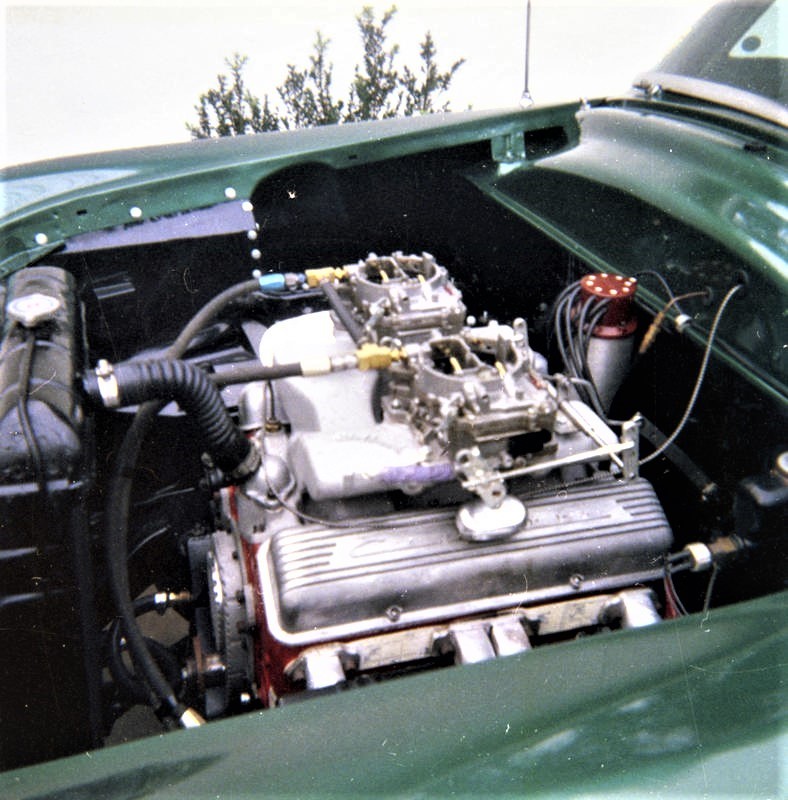
About the time I was ready to rebuild the 283 Chevrolet engine, Corvette came out with a high performance 327 cubic inch engine that was rated at 360hp, and I had to have one! I didn’t have the money to buy a complete new engine, so I decided to rebuild my 283 heads and use them on a new short block until I had the money to buy a pair of Corvette heads. To complete the engine, I bought a used Corvette 2 x 4 intake manifold and carburetors, along with a new Corvette distributor.
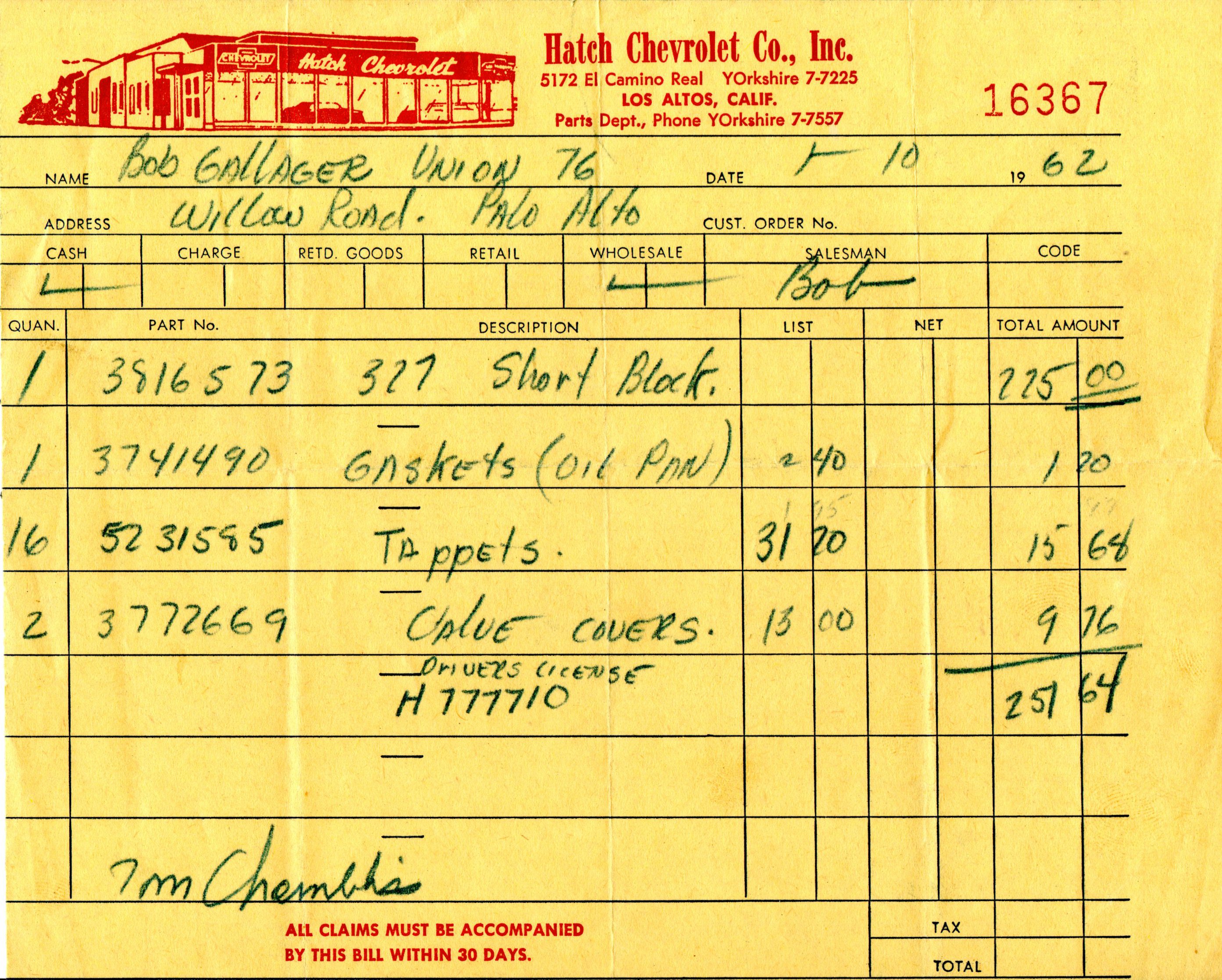
By March of 1962 the engine installation was complete, and I started the engine and drove the car around the block. The only thing missing was the mufflers and tail pipes. On his way to work one morning, my father towed the ’54 to a muffler shop in Menlo Park where he dropped me and the Ford off to have the exhaust system made. After waiting around for the exhaust to be completed, I took my first test drive, driving back to Mountain View. Everything worked perfectly on the drive home. But in April, after driving approximately 200 miles, I decided to see how the car would leave from a dead stop under-power, a big mistake. The car moved hard for 15 feet and then broke the cast-iron PowerGlide transmission. This laid the car up for a month or so while I rounded up parts to change to a stick shift. I replaced the automatic with a used Chevrolet 3-speed manual transmission and floor shifter (unknown brand), along with a new Schiefer clutch and aluminum flywheel.
I also had to install a clutch pedal assembly and related linkage. As it turned out, I was able to use all the stock clutch linkage from a 1958 Chevrolet passenger car with the exception of the clutch pedal, which I bought new from a Ford Dealer. The 3-speed transmission only lasted a couple of months, breaking and rebuilding it twice. I then tracked down and bought a used T-10, 4-speed transmission and floor shifter out of a 1960 Chevrolet passenger car. The 4-speed solved my transmission problems, I never broke a transmission again until I increased the engine’s horsepower, and started drag racing the car.

The engine ran great and the car had now become a hot street car with all the creature comforts, and yet was still very reliable. I put a lot of miles on the car using it as my work car, cruising the local drive-in restaurants nightly, and making several trips to places like Lake Tahoe.
Even though the car’s upholstery was in like-new condition, I had the interior re-upholstered by Adams Upholstery Shop, in Palo Alto, Calif., in the same style and material as a 1957 Chevrolet Bel Air. Over the next year I replaced the 283 heads with a new pair of 360hp Corvette heads. I also replaced the stock 1954 Ford rear axle housing with a Halibrand quick-change that used 1948 ford axle housings, with 1950 Mercury pull-out axles and spider gears. And because of the size of the quick-change, I had to remove the stock Ford fuel tank and replace it with a 7-gallon aluminum fuel tank made by the Moon Equipment Co. of Santa Fe Springs, Calif., which I mounted inside the trunk.
The rear suspension consisted of the two stock semi-elliptic Ford springs, and bottom traction bars made by the Traction-Master company of Burbank, Calif. During the early part of 1963, after testing several different intake/carburetor set-ups, and building a set of individual tube headers, the Corvette engine was finally making its advertised horsepower. I was now testing different rear and front suspension settings, following articles that I had read in car magazines to improve the car’s traction.
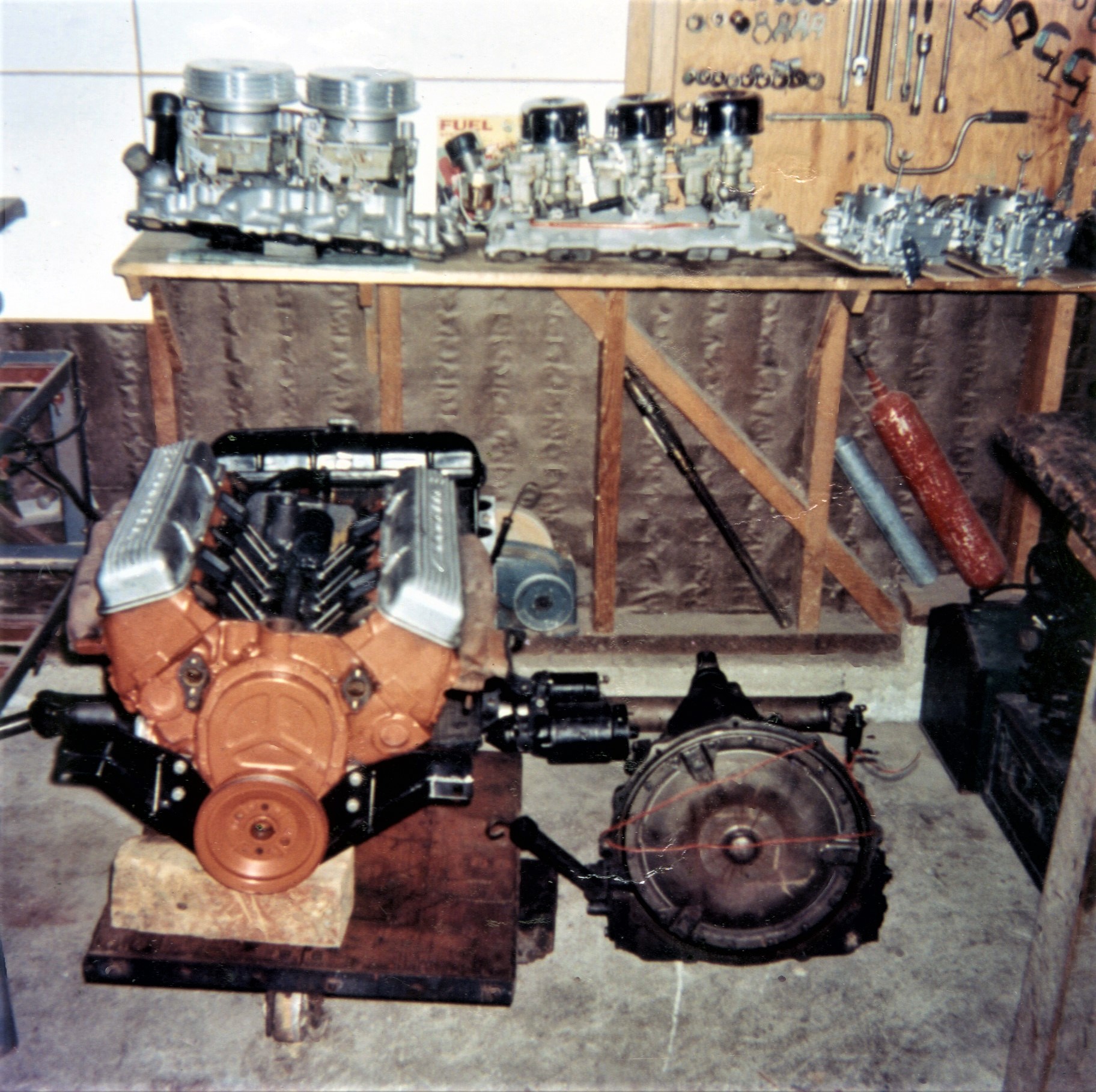
There was one problem with the new engine, the chrome piston rings had never sealed correctly, causing excessive oil blow-by under full power. This was most likely caused by not breaking the engine in correctly. I decided to remove the engine to fix the problem by boring the engine .030 oversize and changed to higher compression pistons using cast iron rings. I also changed to a higher lift camshaft. These changes made a huge increase in the engine’s horsepower.
I was now doing a lot of street racing, usually a couple of times a week, either from a dead stop on some back road, or from a rolling start pulling onto a freeway. I didn’t seem to have any problem beating the factory built super stock cars, like the 409 cubic inch Chevrolet, or the 406 or 427 cubic inch Fords. But in the summer of 1963, there was a new car in town, a factory-built Plymouth with a 426 cubic inch Max Wedge engine, which was purchased by Mel Gibson, another Mountain View guy. The first time I saw the car it was cruising through Johnny Mac’s drive-in restaurant late one night, and it sounded super-hot! I never got a chance to race Mel, but I’m pretty sure I couldn’t have beaten him, as they were advertised to run elapsed times in the mid to low 12-second range right off the show room floor!
By the summer of 1963 I felt it was time to see how quick and fast the ’54 really was. On Sunday, August 18, I drove over to Fremont Drag Strip with a friend, Gary Clarke, to find out. On the car’s second run with street tires, it ran an elapsed time of 12.95, and a speed of 106.99 mph. I was really pumped up after leaving the race track that afternoon. So much so that I left on the “class” shoe-polish numbers the drag strip had put on my car windows when I went out cruising the drive-ins that Sunday night. I was hooked! I started racing the car almost every weekend, and by September I decided to make the car a full-time race car, occasionally driving the car on the street. I usually prepared the car to race on Saturday and then towed the car to the races on Sunday.
During a run at Fremont Drag Strip in January of 1964, I exploded a clutch, sending clutch parts through the cowling just in front of the windshield. I had the car repaired by a friend, Bill Moranville, at his father’s body shop in Mountain View. Bill decided to paint the car a different color, one that would match the original green color of the ’54’s dash and window frames. The color he picked was a 1958 Cadillac Forest Green, which was almost a perfect match of the stock Ford green dash.
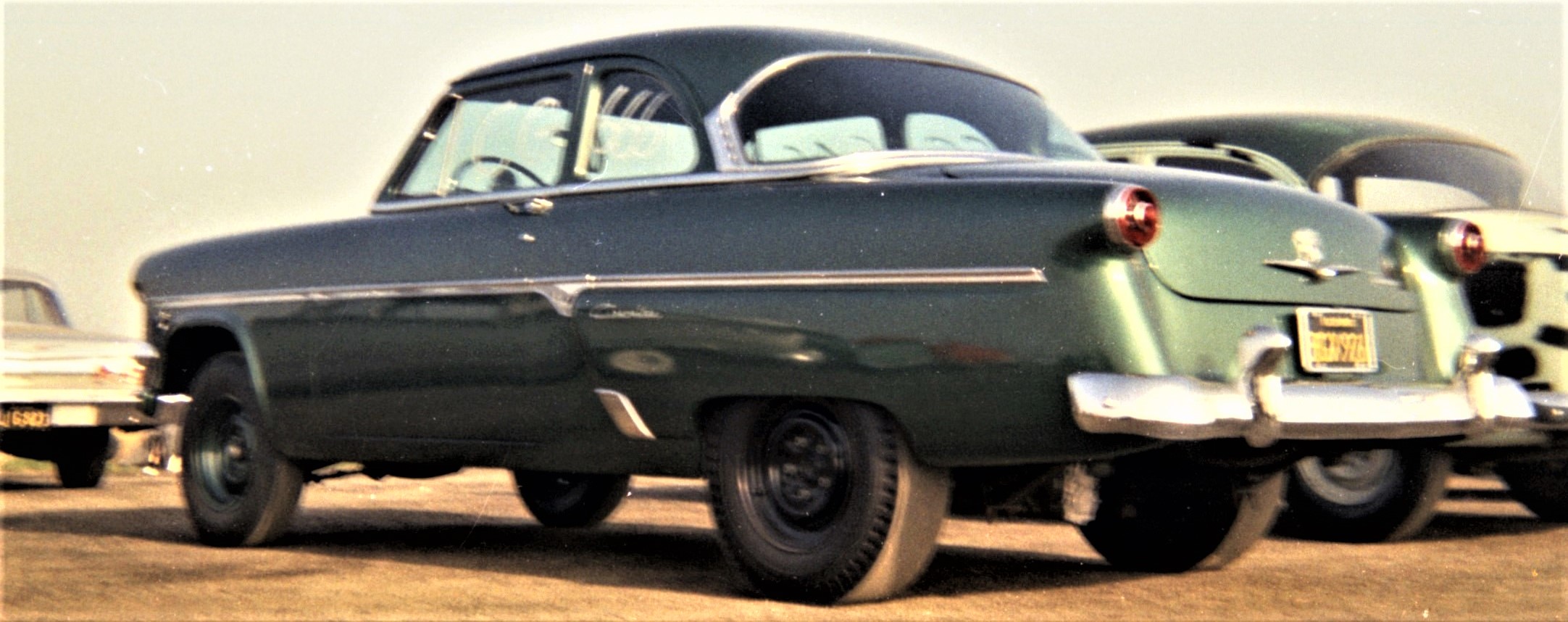
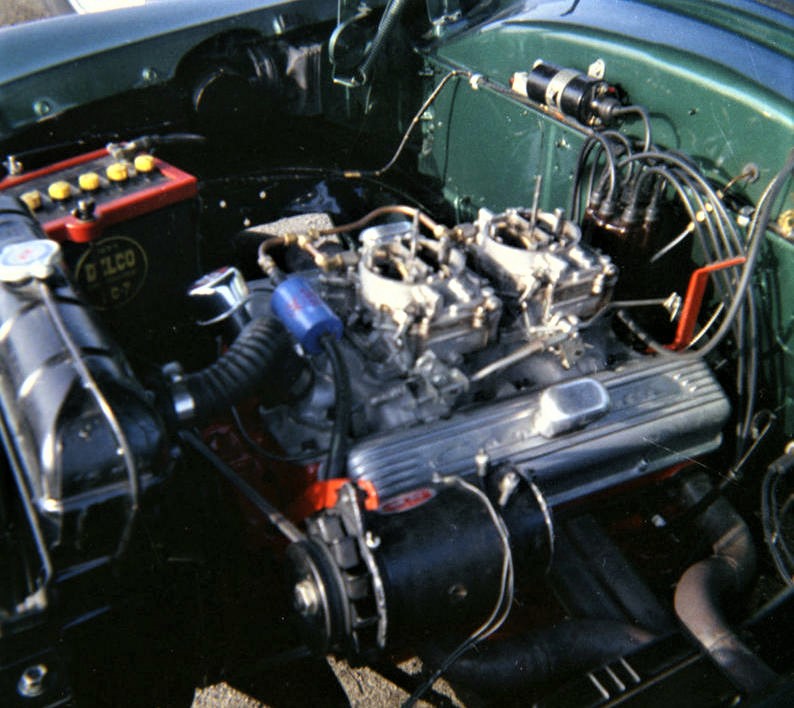
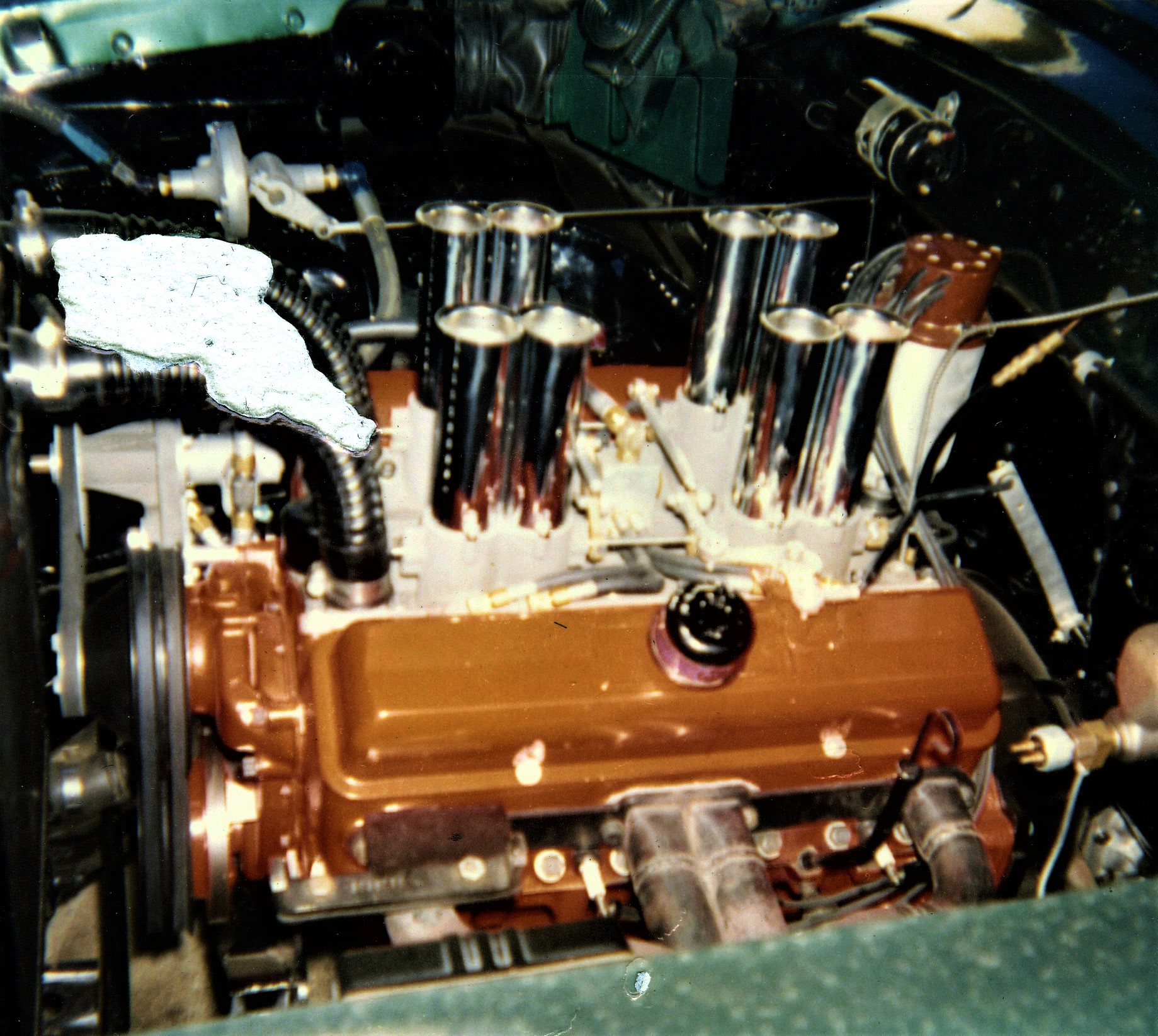
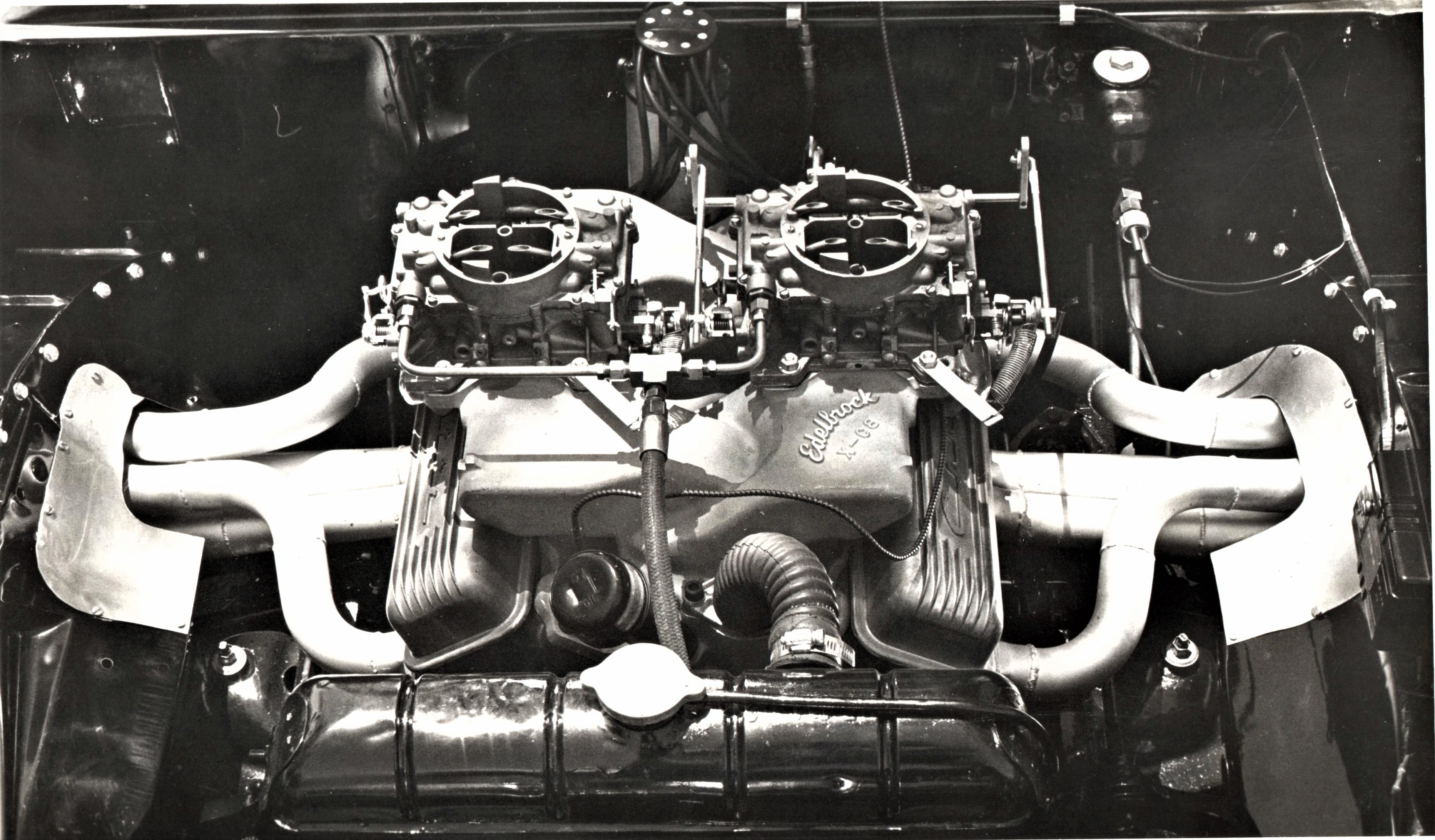
In May of 1964, I switch to Hilborn Fuel injection and with the increase in horsepower the Halibrand quick-change differential became the weak link, breaking it on several occasions. I first replaced it with a 1957 Chevrolet housing, but that didn’t hold up either, so I replaced it again, this time with a 1959 Oldsmobile housing using rectangular tubing lift-bars to control the traction. At the time lift bars were very popular with the factory Super Stock Cars and worked extremely well.
I got married in July 26, 1964, and rented a duplex at 1906 Rock St., and the following year we moved to another duplex at 555 California St. And even though both duplexes had small one-car garages, I was happy, because this was the first time the ’54 had a garage since I owned the car.
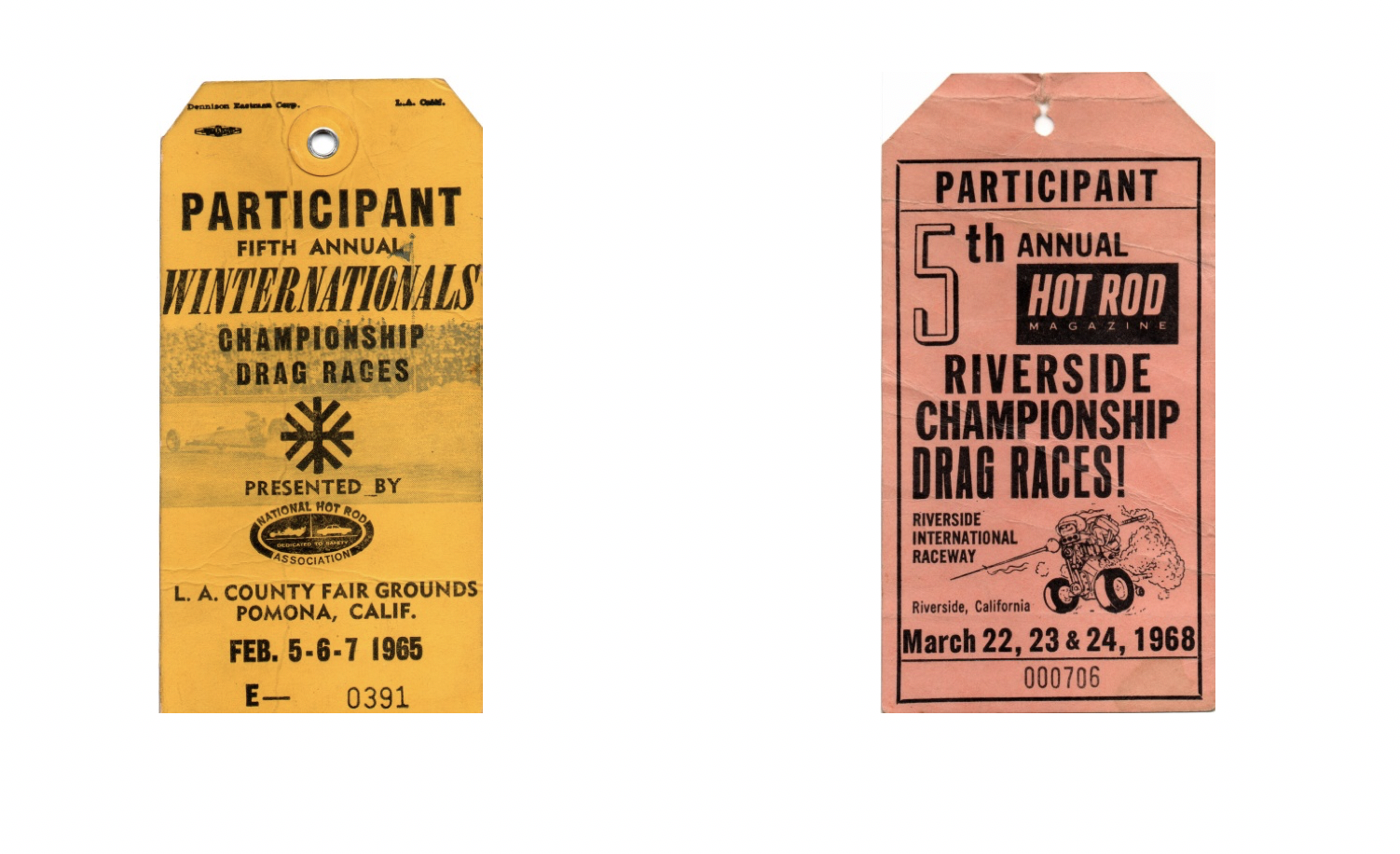
After racing the car in the C Modified Production class at the 1965 WinterNationals, using a ram-log manifold, I set the car up to race in the C Gas class, switching back to Hilborn fuel injection. The car was now running consistently in the low 12-second range, with a best elapsed time of 12.08, and a speed of 115.03 MPH.
Over the next couple of months, I competed in several different classes that kept the cars’ weight to cubic inch ratio approximately the same, and I never used a rear tire wider than 9 inches. The car’s average weight was around 3400 pounds, and in order to move that weight quickly from a dead stop I used rear-end gear ratios of between 5:20, to 5:57 to one.
In May of 1965, a friend, Frank Bertuccio, who owned and operated a small business in town that made extra-large magnesium and fiberglass garbage cans for the cities of Mountain View and Sunnyvale, offered to make me a lightweight hood out of fiberglass to reduce the front sprung weight of the car, and it would also look cool. Bill Moranville and I made the “hood mold” for Frank, using an old stock 1954 Ford hood.
By the middle of 1966, I was building race cars and suspensions for other people, and I didn’t have the time to maintain the ’54 as a race car, so I decided to sell it. I was also building a 1950 Anglia sedan for myself to race in the A/Gas class, which I had bought less its engine and transmission in 1965 from a person in Alameda, Calif.
At the end of 1966, I sold the ’54 to a couple of local guys (one later becoming my partner in a funny car). The two raced the car for a couple of years with me doing the driving, and in 1968 they sold the car less its engine and trans to a Mickey Miller, who at the time lived in Sunnyvale, Calif. The engine was later sold to Les Haynes, a friend I worked with at Fairchild Semiconductor. And after changing the camshaft and installing a four-barrel intake manifold, Les put the engine in his 1963 Corvette that he had recently bought from another friend, Ron Rinauro.
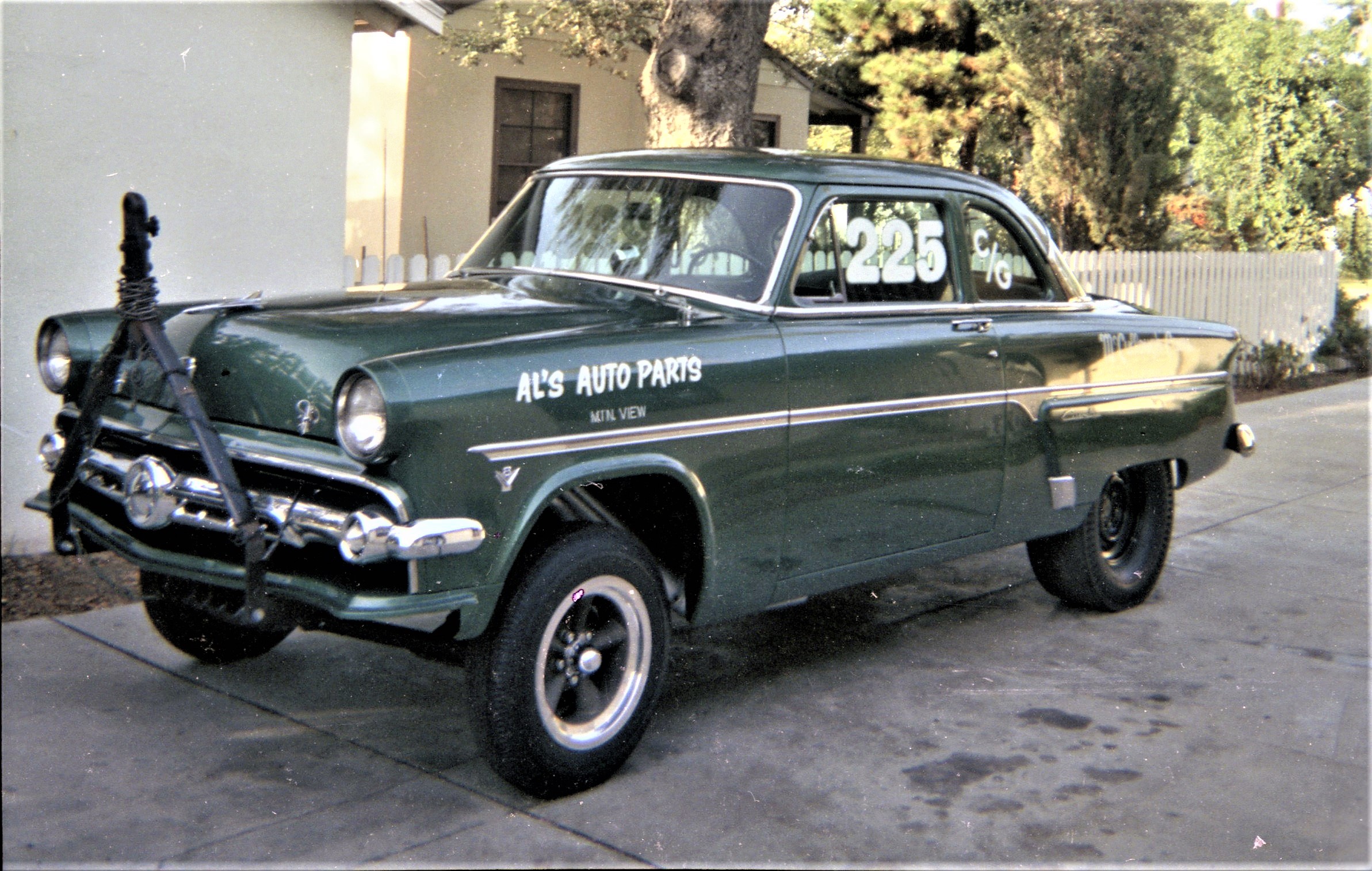
The ’54 became a real campaigner. Over the years it had been flat-towed several thousand miles traveling to different drag strips in California, which included Fremont, Half Moon Bay, Vacaville, Long Beach, Pomona, and Riverside. When the car was sold it had 19 class wins, and a couple eliminator bracket wins to its credit.
Unfortunately, no one has seen the car since it was last sold in 1968. Myself and others have tried to track it down, with no luck. It most likely has been parked in someone’s garage waiting to be found.

 Tom Chambliss: A Life in Stories
Leave a comment