Ken Kline’s 1950 Ford (1959 to 1961)
Ken Kline was one of the neighborhood kids who lived around the corner (at 430 Sierra Ave.) from my parent’s house. He was a year older than me, good looking, smart, athletic, with a personality adults loved. He was definitely more mature than the rest of us neighborhood kids. In his junior year of high school he applied for a part-time job stocking shelves at our local Lucky’s grocery store. He got the job and became a member of their union. A couple of months after starting the job, he purchased his first car, a like-new 1950 Ford Business Coupe.
Ken and I started hanging out more when I became a sophomore in high school, probably because of our interest in cars. He was interested in cars like the rest of us that hung out together, but not so much for the car’s appearance, as its performance, and he talked about someday hopping up the motor in his new Ford. After stocking shelves for a couple of months he was promoted to part-time checker, which was pretty rare at the time for a high-school kid. The job paid some serious money, and it wasn’t long before he had more money than he knew what to do with.
When Ken bought the Ford coupe he planned on adding a few performance parts to its V8 engine to increase its horsepower, and also replace the column shift Ford transmission with a much stronger La Salle floor-shift transmission. But after his promotion to checker, he now had the money to replace the 100 horsepower flathead engine with a more modern overhead valve engine. After doing some research on different types of engines he decided to replace the Ford engine with a Chrysler Hemi engine, which in stock form had 130 horsepower more than the Ford engine.
Ken’s new plan was to buy a used Chrysler engine, and rebuild it using high-performance parts to increase its horsepower. He found and bought a used 1954 Chrysler Hemi engine at one of the local auto wreckers. I don’t remember how we got the heavy 830-pound engine to Ken’s parent’s house, maybe the auto wrecker delivered it? Once there, we took the engine apart, cleaning and organizing the parts to be sent out for machining.
We got some help from Ken’s father who worked for a piping supply company in San Francisco (his father commuted to SF by train on a daily basis). He created a swing type structure that a chain hoist was attached to, so we could remove and install the engines. The structure was made out of water pipe, and pipe fittings, with most of parts coming home on the train with his father. Ken’s house had a single car garage with a garage door facing the street, and a garage door facing the patio, a true drive-through garage. There was a small stand-alone workshop in the backyard that Ken’s father had built, which we used to work on the motor. The Kline house was the perfect place for working on the car.
Ken purchased the hardware to install the Chrysler engine in the Ford chassis from Bell Auto Parts, located in Bell, Calif. They included: the front motor mounts, a dropped tie-rod to clear the Chrysler oil pan, an aluminum bellhousing that adapted the Chrysler engine to a La Salle transmission, and a rear transmission mount. Once we had the Hemi engine parts cleaned up, we test fit the bare block and heads in the Ford engine compartment to see how it fit. The only problem we found was a little sheet metal that needed to be removed from the lower part of the firewall to clear the new bellhousing.
When the parts were returned from the machine shop we painted the engine block and heads, and then organized the parts for assembling the engine. One Friday evening with very little knowledge of the internal parts of a Chrysler engine, Ken and I started assembling the engine using a Chilton Auto Repair Manual as our guide. The performance parts Ken had purchased to increase the engine’s horsepower included: Jahn’s high-compression pistons, Howard camshaft and lifters, high-volume oil pump, full-flow oil filter, and a Schiefer clutch and aluminum flywheel. The heads were lightly ported and milled. Topping this off was an Edelbrock 4 x 2 log intake manifold and Mallory ignition. Other than a pair of “Traction Master” traction bars, no changes were made to the stock rear-axle housing or differential.
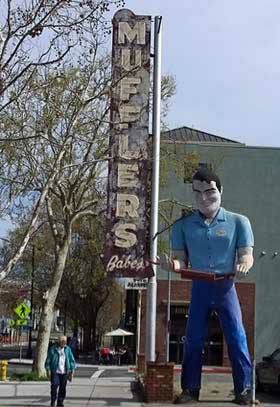
After assembling and installing the engine in the coupe we took it to Babe’s Muffler Shop in San Jose, Calif. to have a custom exhaust system built, something we had dreamed up. The system consisted of the eight individual tubes running under the car to four separate collectors. From there the exhaust ran through two glass pack mufflers and tail pipes that exited the rear of car. It was a real work of mechanical art.
After Babe’s completed building the exhaust system, we brought the car back to Ken’s home to add a couple of Stewart-Warner gauges and finish wiring the car’s electrical system. The car’s outside appearance and interior were left totally stock, including the wheels, tires, and hub caps. The look Ken wanted was a “sleeper”. At the time, if a car looked stock in appearance and had a modified engine to increase its horsepower, it was usually referred to as a sleeper.
We were now ready to start the engine. After topping off the water and oil we tried starting the engine. Even with a low battery the engine turned over a couple of times and started, running for 3 or 4 minutes before it stopped running for some unknown reason. After checking the fuel pump, ignition coil, and anything else that might keep the engine from running, we started it again. This time it ran for a shorter period of time before stopping, acting like it was seizing up. With the battery low (we didn’t have a battery charger), we thought about pushing the car down the street with another car to try and restart it, but we determined there must be a major internal problem with the engine. So we removed the oil pan and checked the bearings. We found two bad rod bearings, which is what caused the engine to seize up.
We removed the engine from the car and took it apart. After further checking we found one of the crankshaft rod journals had been ground .003 undersized, and the other three journals were standard. So without knowing, we had installed an oversize bearing on a standard rod journal during the assembly of the engine. Ken’s father had made the arrangements with a local machine shop to do the machine work on the engine, and must have known about the undersize rod journal. But it was never passed-on to us. We took it for granted that all the rod bearings were the same size. We did notice the engine getting harder to turn over as we were assembling it, but not having much experience with engines, we thought this was normal.
Because the engine only ran for a few minutes, there wasn’t much damage to crankshaft, but the rod bearings were history. The crankshaft was sent out to have all the rod journals ground to the same size, .010 undersize. At the time it wasn’t unusual to grind just one rod journal undersized a couple of thousands. Today that wouldn’t happen, all the journals would be ground to the same size.
Unfortunately, about the time the crank was sent out to be ground, Ken’s parents decided to get a divorce. During the next couple of months everything came to a standstill. Ken’s dad moved out, the house was put up for sale, and his mother moved to an apartment. The dissembled Chrysler engine was sold to Eric Rudberg, a high-school friend of Ken’s who planned on putting the engine in a Model A Ford coupe. The 1950 Ford was sold to an unknown person. Ken was now out of high school and decided to join the Navy. After serving his time in the Navy, he attended Cal Poly in San Luis Obispo, Calif. earning a degree in agriculture.
Eric Rudberg also attended Cal Poly and in his second year of school he contracted meningitis which he later died of. It’s unknown what happened to the Hemi parts he bought from Ken and the Model A coupe. It’s too bad things ended the way they did. I wish we could have gotten the time to put the engine back together, and get Eric’s car running, if for no other reason than to show it off.
 Tom Chambliss: A Life in Stories
Leave a comment